

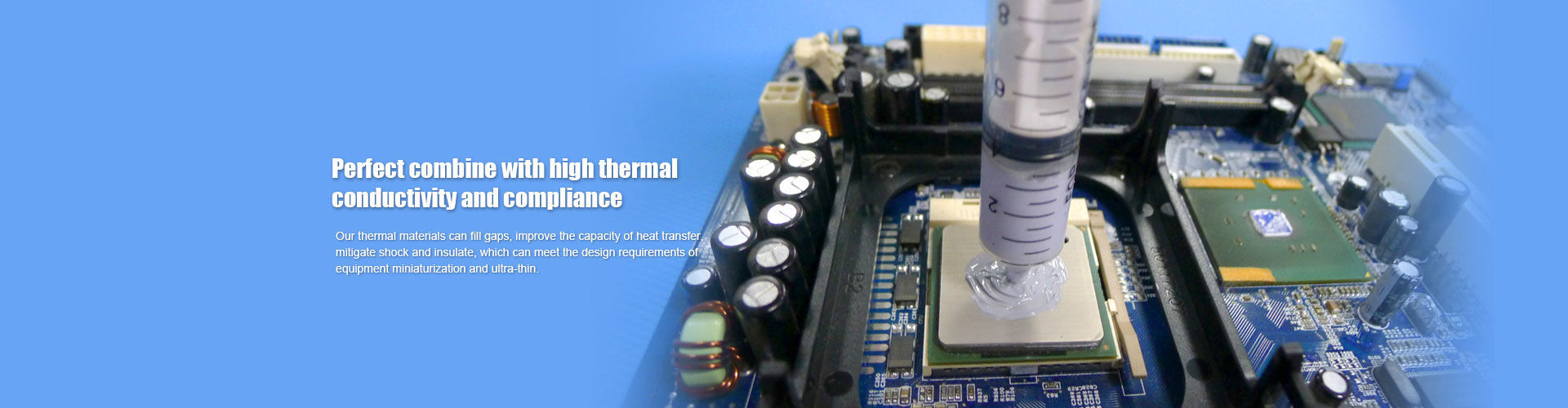
Technical Parameter Comparison and Industrial Selection Guide for Thermally Conductive Silicone Pad, Thermally Conductive Silicone Cloth, and Graphene Heat Spreader
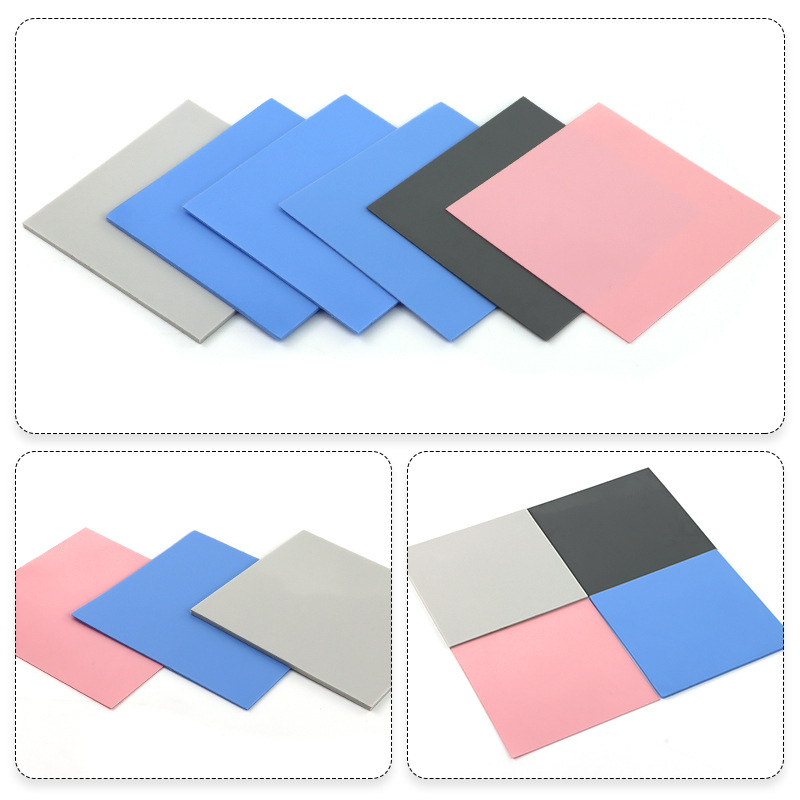
In the field of electronic device thermal management, thermally conductive silicone pads, thermally conductive silicone cloth, and graphene heat spreaders are three mainstream thermal interface materials. They differ significantly in thermal conductivity, electrical insulation, compressibility, and application scenarios. This article systematically analyzes the core parameters and selection logic from the perspective of materials science and engineering applications.
1. Thermally Conductive Silicone Pad: Soft Filling and Pressure Adaptability
A thermally conductive silicone pad is made of silicone elastomer as the matrix, filled with thermally conductive ceramic powders such as alumina or boron nitride, and produced via calendering or coating. Its typical thermal conductivity ranges from 1.0 W/m·K to 6.0 W/m·K, with some high-end products reaching above 8 W/m·K. The most outstanding features are high compressibility and low interfacial thermal resistance: under a low pressure of 0.5 to 2.5 MPa, the compression ratio can reach 30% to 50%, perfectly filling irregular gaps between PCBs and heat sinks, or between chips and shielding covers. The silicone pad is electrically insulating, with a breakdown voltage typically >4kV, and also provides vibration damping and acoustic absorption. The operating temperature range is generally -40°C to 200°C. Typical applications include power modules, LED lighting, automotive electronic control units (ECUs), and 5G base station power amplifier modules.
2. Thermally Conductive Silicone Cloth: High Voltage Endurance and Tear Resistance
Thermally conductive silicone cloth (also known as thermally conductive silicone rubber sheet with fiberglass reinforcement) uses glass fiber fabric as a reinforcing backbone, coated on both sides with thermally conductive insulating silicone. Its thermal conductivity usually ranges from 0.8 W/m·K to 2.5 W/m·K. Although this is lower than that of high-end silicone pads of the same thickness, its advantage lies in extremely high dielectric strength – from 6kV to 10kV or higher – and its tensile strength and tear resistance are far superior to ordinary silicone pads. Silicone cloth is relatively thin, typically 0.2mm to 0.5mm, with lower thermal resistance, making it suitable for high-power semiconductor devices that require strong insulation and very small gaps, such as IGBT modules and MOSFET-to-heatsink interfaces. However, note that silicone cloth has poor compressibility and requires a flat mating surface.
3. Graphene Heat Spreader: Ultra-High In-Plane Thermal Conductivity and Lightweight
A graphene heat spreader is a thin film material made by exploiting the excellent two-dimensional thermal conductivity of graphene. Its in-plane thermal conductivity can reach 800 to 1500 W/m·K, two to four times that of copper or aluminum, but its through-plane thermal conductivity is relatively low (approximately 5 to 20 W/m·K). This anisotropy makes the graphene heat spreader very effective at quickly spreading heat from a point source in the horizontal direction, eliminating local hot spots. Its density is only 1.0 to 1.5 g/cm³, much lower than metals. However, graphene heat spreaders are not electrically insulating; their surface resistivity is very low, so they typically need an insulating layer or can only be used in applications where electrical insulation is not required. Typical applications: smartphone vapor chambers, tablet backlight heat dissipation, heat spreading above laptop CPUs, and wearable devices.
4. Selection Comparison Table (Key Parameters)
| Material | Thermal Conductivity | Electrical Insulation | Compressibility | Tear Strength | Primary Function |
|---|---|---|---|---|---|
| Silicone Pad | 1.0–6.0 W/m·K | Good (BVD >4kV) | Excellent | Moderate | Gap filling, cushioning, insulation |
| Silicone Cloth | 0.8–2.5 W/m·K | Very high (>6kV) | Poor | High | High‑voltage insulation, small‑gap heat transfer |
| Graphene Spreader | In‑plane 800–1500 | None (conductive) | Non‑compressible | Low (brittle) | Lateral spreading, hot‑spot elimination |
5. Engineering Selection Recommendations
For large gaps, wide tolerances, and applications needing vibration damping, prefer a thermally conductive silicone pad.
For high‑voltage safety requirements (e.g., power supplies, motor drives) with very small gaps, thermally conductive silicone cloth is mandatory.
For high‑density local heat generation that requires rapid temperature equalization without insulation requirements, use a graphene heat spreader.
Combinations are also possible: attach a graphene spreader directly on the heat source, then cover it with a silicone pad or cloth to achieve both heat spreading and electrical insulation.
6. Conclusion
Thermally conductive silicone pads, thermally conductive silicone cloth, and graphene heat spreaders each have unique thermophysical properties. There is no universal material. Engineers should make quantitative judgments based on gap size, required breakdown voltage, thermal conductivity directionality, and mechanical flexibility. Proper selection of thermal interface materials can reduce junction temperature by 10–20°C, significantly improving the reliability and lifespan of electronic products.
 PORON Foam vs Rogers Foam: Tec
 How to Choose Thermally Conduc
Technical Parameter Comparison
How to Choose Thermally Conduc
Technical Parameter Comparison
 PET Mylar Sheet and Mylar Pape